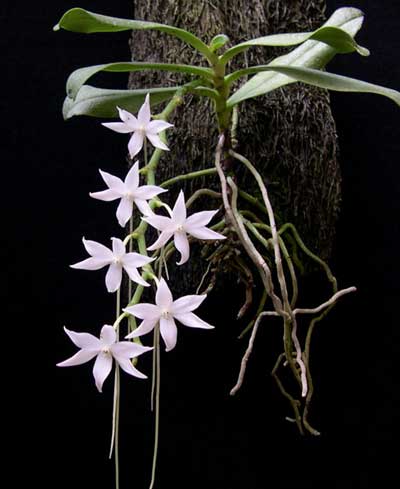

🌿 General Characteristics
The Angraecum genus includes about 200 species of epiphytic orchids, without pseudobulbs, native to Southern Africa and predominantly found in Madagascar. Their sizes vary greatly: some species are almost miniature, while others produce vigorous plants with very large flowers. The flowers are pure white, sometimes with greenish, yellow, or pinkish hues. 🌸
The most famous species is Angraecum sesquipedale, discovered by Darwin in the mid-19th century: it has very large, intensely fragrant (especially in the evening) white star-shaped flowers, with a spur that can reach 25-30 cm. The plants can grow up to 30-40 cm tall and develop long silver-green aerial roots. 🌟
☀️ Exposure
Angraecums love intense light, but should be protected from direct sun during the hottest hours and in summer. They also thrive on a windowsill, with a light curtain to filter the light. They are sensitive to cold: the ideal night temperature is above 15°C. In summer, a shaded, cool, and well-ventilated spot is best, avoiding prolonged exposure above 35°C. 🌡️
💧 Watering
Angraecums do not have a true resting period, so they should be watered regularly throughout the year, keeping the substrate slightly moist. However, be careful of waterlogging: it can quickly cause root rot. After flowering, slightly reduce watering for a couple of months. During growth and flowering, fertilize every 20-25 days with orchid-specific fertilizer at half strength. 🌱
🪴 Substrate and Repotting
Like all epiphytes, Angraecums are grown in small pots filled with shredded bark, pieces of polystyrene, perlite, and other draining materials, simulating the conditions of Madagascar's forests. Repot only when the roots are constrained in the pot, choosing a container that is only slightly larger. Before repotting, water the roots thoroughly to make them more flexible and less fragile. ♻️