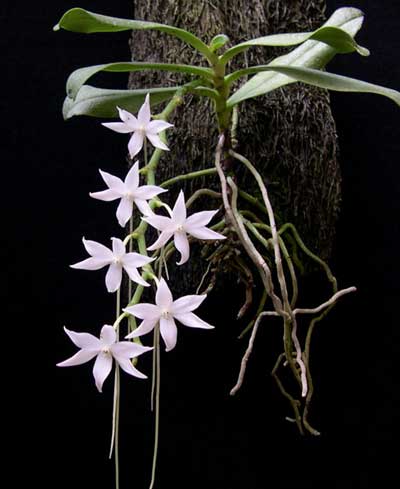
The genus Dendrobium includes species native to all of eastern Asia, from the Pacific to the Himalayas, Australia and New Zealand.
It is certainly one of the largest genera in the orchid family, comprising more than 900 species that live in very diverse habitats: from sea level to altitudes of up to 3,500 m, some in temperate regions, others where temperature and humidity are constant year-round, and others in tropical climates. This means that Dendrobiums have very different cultivation requirements, shapes, and sizes: we find very small Dendrobiums measuring 3-4 cm, and very large Dendrobiums several meters long, with diverse shapes and colors that make this species unique and irreplaceable for orchid lovers.
All of this is complicated by the fact that there are numerous hybrids and consequently many types of Dendrobium on the market.
The morphology of Dendrobiums is very different from one another, in fact we find species with evergreen leaves and others with deciduous leaves, some with single leaves, others gathered in groups.
A characteristic that the different groups have in common is that of forming keiki (photo on the side) both at the height of the nodes and at the base of the stem which are nothing other than a new orchid plant that, once sufficiently large, can be detached from the mother plant and repotted independently.
Generally speaking, to understand how to grow Dendrobiums, keep in mind that they are plants with a very rapid vegetative period, meaning they develop their green parts and roots very quickly, but take much longer to flower and produce seeds. This situation is dictated by the fact that in nature, the vegetative dormancy corresponds with the seasons least favorable to their growth, namely cold and dry conditions. These conditions would make the plant unable to survive without entering a dormant period, drawing on the reserves stored in the pseudobulbs during the full development phase. In nature, this unfavorable period is longer than the favorable periods, which is why they have this particular cycle.
Given that these plants grow in such diverse habitats, it's impossible to make generalizations about their cultivation techniques. For this reason, some divide Dendrobiums into six groups, describing the typical cultivation environments for each.
FIRST GROUP
This group includes deciduous and cold-house Dendrobiums that require a period of vegetative rest.
We find the following species:
- Dendrobium nobile;
- Dendrobium chrysanthum;
- Dendrobium wardianum;
- Dendrobium victoriae reginae.
Here we find Dendrobium nobile, certainly the most famous of the species in this group.
They are all plants native to Southeast Asia including Nepal, Bhutan, north-eastern India, Burma, Vietnam, Laos and part of south-eastern China, at altitudes between 200 – 1500 m.
This group, like the second, has the peculiarity of losing its leaves during the dry, low-temperature period that in nature coincides with winter. During this period, since there is insufficient water and temperature for growth, the plant enters a vegetative dormancy, losing its leaves and thus conserving its nutrient reserves and living off the reserves stored in its pseudobulbs. With the arrival of heat and rain, it quickly replenishes its reserves and prepares for reproduction, that is, flowering and seed production (let's never forget that plants flower to propagate the species).
In addition to these species, there are also numerous hybrids obtained mainly by crossing Dendrobium nobile x phalenopsis or Dendrobium nobile x Dendrobium bigibbum.
For these orchids the cultivation cycle is particular and is also valid for the resulting hybrids.
From mid-autumn (November) until mid-winter (February), they should be kept in a cold greenhouse with temperatures around 10°C, in a very bright location (in their natural habitat, light is much more intense in winter than in summer), with very little water—just enough to prevent wilting—no fertilization, and excellent ventilation. The amount of water you need can be adjusted by observing the stems: if they begin to wrinkle, you need to water them a little, but very little. The lower the temperature, the less water you need.
As soon as the flower buds appear, which typically coincides with spring, you can water them occasionally until flowering ends. Once the last flower has fallen, stop watering again until roots begin to emerge from the new shoots. At that point, the plant should be moved to an area with warmer temperatures and regular watering and fertilizing should resume. During this time, they can also be moved outdoors. During this time, the light should not be too intense.
Throughout spring and until mid-summer (August), fertilization must have a high nitrogen content at a dose of 1/2 g/l once a week.
After that, from mid-summer (August) until autumn, continue with fertilizers with a very low nitrogen content and a high phosphorus and potassium content at a dose of 1/2 g/l once a week.
This alternation of dry, cold periods with normal, warm periods is essential for flowering. In fact, the primary cause of non-flowering in this group of orchids is precisely the lack of this alternation. Instead, the plant will produce keiki, which are simply new seedlings that, once large enough, can be separated from the mother plant and repotted independently.
In summary, to successfully grow Dendrobiums of this group and their hybrids, two fundamental requirements are needed: in spring
– very hot summer, lots of fertilization, constant humidity and not too intense light, immediately followed by a cold, dry period, no fertilization and lots of light until flowering which will occur at the end of winter – beginning of spring.
Dendrobium can easily be kept outdoors during the summer months but must be accustomed to it very gradually. It tolerates direct sunlight once it has grown outdoors if acclimated early in spring and if ventilation is excellent.
As for humidity, it must be high during the summer, around 80%, which is gradually reduced as winter approaches to 60% until it is suspended altogether in winter.
As for repotting, it can be done either when the new roots begin to develop or immediately after flowering.
SECOND GROUP
This group includes deciduous and intermediate greenhouse Dendrobiums that require a period of vegetative rest.
- Dendrobium anosmum;
- Dendrobium findlayanum;
- Dendrobium pierardii;
- Dendrobium parishii;
- Dendrobium heterocarpum;
- Dendrobium aggregatum.
This group, like the first, has the peculiarity of losing its leaves during the dry, low-temperature period that in nature coincides with winter. During this period, since there is insufficient water and temperature for growth, the plant enters a vegetative dormancy, losing its leaves and thus conserving its nutrient reserves, living off the reserves stored in its pseudobulbs. With the arrival of heat and rain, it quickly replenishes its reserves and prepares for reproduction, that is, flowering and seed production (let's never forget that plants flower to propagate the species).
Species belonging to this group are bred like those of the first group, with the only difference being that temperatures are constant year-round, around 12-14°C at night.
Vegetative rest must be ensured starting from autumn and throughout the winter, when irrigation will be gradually reduced and at the end it will be watered just enough to prevent it from withering and irrigation will be suspended.
Stop fertilizing completely. When flower buds begin to appear and are fully developed, which coincides with spring, gradually resume watering until you see the plant has fully recovered and is producing new roots. At that point, you can resume regular watering and fertilizing. During this period, spring and summer, they require plenty of light and ventilation.
Vegetative rest is essential to induce flowering.
THIRD GROUP
This group includes evergreen and intermediate greenhouse Dendrobiums that do not require a vegetative rest period but must be sensitive to the change of season.
We find the following species:
- Dendrobium chrysotoxum;
- Dendrobium densiflorum;
- Dendrobium fimbriatum;
- Dendrobium moschatum;
- Dendrobium thyrsiflorum;
- Dendrobium farmeri.
These Dendrobiums, unlike those belonging to the other two groups, must not be left dry at any time of the year.
During autumn and winter, watering should be reduced but not suspended and they should be placed in a cool place with night temperatures around 10-12°C.
In spring, watering is gradually increased and the plants are generously fertilized. They are then moved to warmer, brighter environments and can be safely grown like Cattleya.
FOURTH GROUP
This group includes evergreen and intermediate greenhouse Dendrobiums that require a short dormant period.
We find the following species:
- Dendrobium daerei;
- Dendrobium loddigesii;
- Dendrobium infundibulum;
- Dendrobium sanderae;
- Dendrobium formosum;
- Dendrobium lyonii;
- Dendrobium macrophyllum;
- Dendrobium schuetzei
For these Dendrobiums, winter night temperatures are around 12°C, while in summer night temperatures should be around 15-16°C. They cannot tolerate temperatures that are too high or too low.
This group of Dendrobiums also requires a rest period of about three weeks, with very little watering and no fertilization. As new shoots begin to form, watering and fertilizing should gradually resume, remembering to always let the substrate dry out between waterings.
FIFTH GROUP
This group includes evergreen and intermediate greenhouse Dendrobiums without a dormant period.
We find the following species:
- Dendrobium stratiotes;
- Dendroblum taurinum;
- Dendrobium undulatum;
- Dendrobium veratrifolium;
- Dendrobium gouldii.
Orchids in this group dislike extreme conditions; in fact, they prefer moderate temperatures and humidity. They require plenty of light and good ventilation. Watering and fertilizing should be regular throughout the year, perhaps slightly reduced during the winter.
If under these circumstances the buds do not flower or fall prematurely, the night temperature should be adjusted better by increasing it slightly.
SIXTH GROUP
This group includes evergreen and warm-house Dendrobiums without vegetative dormancy.
We find the following species:
- Dendrobium phalaenopsis (also known as the Cooktown orchid as it is found near Cooktown in Queensland – Australia);
- Dendrobium superbiens;
- Dendrobium biggibum.
This group includes very popular orchids; in fact, numerous hybrids are available on the market, especially those of Dendrobium phalaenopsis and Dendrobium biggibum.
These plants are native to the tropical areas of southeastern Australia, so they come from areas with hot, humid, and wet summers and rather dry winters. This background is important for understanding how to grow them. In fact, they are hothouse plants.
First of all, it is important to keep in mind that they do not go into vegetative rest, therefore, they must be watered throughout the year.
In spring and summer, which coincides with the active growth phase, they should be watered generously and fertilized regularly, using 1-2 g/l once a week with a high nitrogen content. Summer night temperatures should be around 22-25°C and daytime temperatures 28-30°C. During this period, they should be misted regularly to maintain humidity levels around 60-70%. During the warmer months, they can be exposed to direct sunlight only in the early morning hours, but shaded for the rest of the day.
After flowering, watering should be reduced until the new flower stems form.
From late summer until autumn, use a fertilizer with a higher Phosphorus and Potassium content, always at a dose of 1/2 g/l once a week.
From autumn and throughout the winter, watering should be gradually reduced, allowing the substrate to dry out between waterings. Care must be taken not to let the pseudobulbs shrivel too much, as they recover quite slowly. During this period, fertilization should be suspended or at least significantly reduced, coinciding with the reduction in watering. Misting should be done to maintain relative humidity around 60-70%. In their natural habitats, light is much more intense in winter than in summer, so make sure they receive much more light during the winter than in summer. Winter temperatures are around 12-14°C at night and 15-18°C during the day.
It is important to ensure excellent ventilation throughout the year.
Repotting is done after flowering or when the plant begins to recover in late winter or early spring. Being epiphytic plants, they can easily be grown on cork bark.
Obviously, under these conditions, watering and misting must be done daily, especially in summer. If growing in pots, be careful to use small pots; they don't like large ones. Pots that may seem too small for the plant are usually fine. Furthermore, it's important that they have an adequate number of drainage holes, as they absolutely dislike waterlogging. Cork pieces and fir bark are suitable substrates. Repotting is usually done when the plants have outgrown their pots. If you decide to divide the plant, remember to leave at least three pseudobulbs per plant.
In almost all Dendrobiums belonging to this genus, the flowers appear at the terminal part of the flower stem in numbers varying from 5 to 20 and last from one to three months.
Once the flowers have dried, it's best not to cut the stem but to let it dry naturally. This stem may then sprout new lateral branches, or it may rebloom, or it may develop a keiki, which is simply a new plantlet that, once large enough, can be separated from the mother plant and repotted independently.
There are cultural differences within the group between Dendrobium phalaenopsis and Dendrobium bigibbum, which are often considered a single species even though they are not. Dendrobium bigibbum is native to areas much closer to the equator and therefore requires higher temperatures than Dendrobium phalaenopsis, especially in winter. They are also morphologically different: Dendrobium bigibbum has smaller flowers and a larger, rounded lip compared to Dendrobium phalaenopsis.
WATERING AND HUMIDITY
Water in the morning to allow the leaves to dry before nightfall, thus preventing the onset of dangerous diseases. Care must be taken to ensure that water does not stagnate between the leaves.
Maintaining a humid environment around the plant is essential. Now, in our homes, it's not always easy to simulate a tropical rainforest. To approximate this, we can place the plant's pot on a saucer (or other container) filled with expanded clay or gravel, and keep a little water in it at all times. This way, the orchid's roots won't come into contact with the water, which, as it evaporates, will create a humid environment around it. Similarly, spraying the leaves once a day is also a good idea.
Keep in mind that optimal humidity varies depending on the species and also in proportion to the temperature: high temperatures will require higher humidity, but in this case it is essential to ensure the plant is well ventilated to avoid dangerous water stagnation that could lead to the onset of dangerous diseases.
For the health of all our plants, it is good practice to equip radiators with a humidifier to prevent the room air from becoming too dry.
FERTILIZATION
Like all orchids, since they are mostly found on inert material, nutrients must be supplied through fertilization.
Fertilizers should be dissolved in irrigation water, preferably not tap water.
Wet the substrate well before proceeding with fertilization to avoid excessive salt concentration.
REPOTTING
Before repotting, the orchid should be thoroughly watered to make the roots more elastic and thus prevent breakage. The roots should be cleaned of any remaining material, and dead roots should be removed with blades or shears that have first been thoroughly disinfected with alcohol or bleach, preferably by flame.
Proceed with great caution and try to disturb the roots as little as possible, being careful to remove only dead roots. Each cut surface should be treated with a broad-spectrum fungicide powder, available from a reputable nursery.
Before repotting, wash the substrate thoroughly by leaving it to soak in water for a few days to eliminate any dust and impurities that end up on the bottom of the container, thus ensuring perfect hydration.
If the roots are too tightly attached to the pot when you repot, it's a good idea to soak the pot in lukewarm water for about 30 minutes. If this doesn't work, cut the pot. Don't force the roots, as this could damage them.
Make sure there is some space between the edges of the pot and the roots to avoid the same situation happening again the following year.
Always make sure that the container you choose has an adequate number of drainage holes (otherwise, equip yourself with suitable tools to increase them).
After repotting the orchid, leave it dry and away from direct light and temperature changes for several days to allow the cut areas to heal and the roots to adjust to the new environment. Once root growth has resumed, resume normal cultivation.
As for the type of container, choose the one you prefer (there are a wide variety of options, so let your imagination run wild here). If you've chosen a specific size, great, buy a smaller one. It's important to disinfect the container first, either with alcohol or bleach. It's also a good idea to clean your hands thoroughly before proceeding, even if you're not wearing gloves.