Historical notes
Knowledge of orchids has evolved at different times and in different ways in the East and West, mainly due to the culture of the people, their religion, their history, but also to the different species present in the territory.
While the Western world witnessed a period of frenetic research during the 19th century (for which the term Orchidelirium was coined) aimed at the discovery and acquisition of new and unknown species, in the East the cultivation of orchids already had a long tradition.
Probably favored by linguistic and cultural barriers, the geographical isolation of the territory and an insufficient flow of information, knowledge of the Eastern world, with particular reference to Japan was, and in some ways still is today, shrouded in an aura of reverent mystery.
Orchid culture was introduced in Japan well before the 19th century and the variety Neofinetia falcata (now Vanda falcata), called Fuuran ( Fūran , 風蘭) – a scientific term which literally means “wind orchid” and which mainly refers to all botanical and wild Neofinetia – was known and cultivated by the Japanese people for over a hundred years, according to the principles of classical horticulture ( Koten engei ) developed in the land of the Rising Sun.
It is said that this particular type of orchid, readily available today, was considered a sacred plant in Japan, and common people were not allowed to possess it. It was the exclusive prerogative of figures belonging to the higher social classes, such as the warrior class, made up of shoguns, daimyos, and samurai, at the top of the social pyramid.
One wonders why a warrior caste found an affinity with this genus of plants and why they dedicated themselves to its care. An unconfirmed theory holds that the answer lies in the flower's shape, whose appearance seems to recall that of the kabuto, the samurai's war helmet. Proper cultivation of this orchid was so important that its cultivation and potting took on a symbolic value, signifying, if done well, the courage and proper training of the warriors.
During the Edo period (1603-1868), under the command of Shogun Tokugawa Ienari (1773-1841), the passion for this miniature orchid reached its peak. The general devoted great attention to the care of these small plants, and his passion was so strong that it is said he covered his collection, consisting of around two hundred specimens, with thin gold or silver nets to protect it. Those lucky enough to admire them were required to cover their mouths with a small piece of paper, called a kaishi (懐紙), to avoid breathing on the precious green jewels, much as one would admire the blade of a katana.
It was precisely in this period that the term Fuukiran (Fūkiran, 富貴蘭) began to enter the current terminology referring to this type of orchid; roughly the term Fuukiran can be translated as "rich and noble orchid" and, still today, it is reserved for all those varieties of Neofinetia selected and registered with the Japan Fūkiran Society (日本富貴蘭会 Nihon Fūkiran Kai ). This adjective generally refers to a selection of Fuuran that have mutated naturally, without human intervention.
The Meiji Restoration (1868) aimed at radically changing the social and political structure of Japan, and brought with it a progressive process of industrialization and modernization along the lines of Western countries. The orchid collecting sector was also influenced by this culture and new, more showy and colorful typologies began to be appreciated by lovers of the genre. The Fuukiran in
At that time they were no longer the focus of orchid collecting in Japan; however, enthusiasts of the genus continued to be interested in and admire them.
Subsequently, from 1926 until the outbreak of World War II, the popularity of Neofinetia rose again. This was the period during which many associations dedicated to them were founded, but this renewed interest in the genus was further halted by the very high cost of plants and the spread of the war.
Only in relatively recent times, more precisely since 1973, has there been a large and organised movement that has brought attention back to this type of orchid.
Today, in Japan, the Nihon Fūkiran Kai is the association that deals with the protection and promotion of the Vanda falcata and their history and boasts over 700 members from all over the world.
In Italy, too, awareness of and interest in Neofinetia has continued to spread in recent years. What once was an elitist and exclusive phenomenon has now become a more widespread and international phenomenon.
Plant: main characteristics
For the Japanese, the beauty of Neofinetia lies in all the varieties that differ from the original and best-known form. This appreciation for atypical forms extends to all parts of the plant, not just the flower, such as the stem (Jiku 軸), the leaves (Ha 葉), and the roots (Ne 根).
Leaf characteristics are considered very important and can be grouped into two main categories: shape and variegation.
The leaves of the most classic form of Neofinetia are thin, long and with a slight downward curve, but the leaves of the other varieties can vary in size, shape, consistency and colour.
The shape of the leaves can be curved downwards or upwards, straight without any curvature, irregular and dishevelled; they can also be long or thin, or “needle-shaped” (Hariba 針葉 ) or short and more or less wide “bean-leaf” ( Mameba 豆葉).
Like leaf shape, variegation is one of the characteristic features of Fuukiran and a key factor in their designation as such. From the most common to the most sought-after varieties, these variations in leaf pattern are not caused by viral infections and greatly increase the plant's value, including its economic value.
Whether it is yellow in color and distributed evenly along the edges of the leaf or transversally with respect to the leaf with a white or yellow color so much so that they can be mistaken for sunburn due to too intense light, variegation is a characteristic that makes these orchids pleasant to admire even when they are not in bloom.
The roots are also of great interest. In fact, the color of the root tips (Nesaki 根先) is a very distinctive feature, as many Fuukiran, similar in shape and color of their flowers, leaves, and stems, can be distinguished from others precisely by the color of the active root tips.
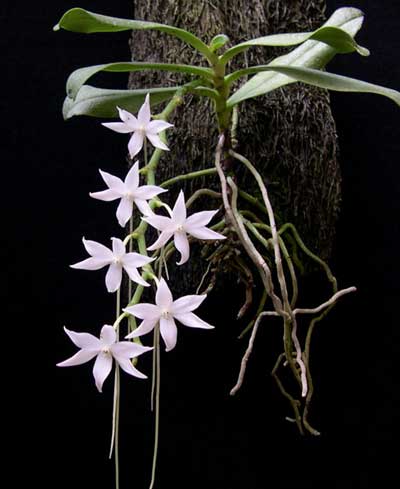
The flowers are mostly white, highly fragrant, and characterized by a long spur. However, there are also botanical varieties with colored flowers, green or pink/magenta.
Cultivation
The Neofinetia genus is characterised by monopodial development (growth along the vertical axis) with a tendency to throw out new lateral vegetation that causes the plant to tiller with age.
The epiphytic plant grows on deciduous trees, thus enjoying strong light in the winter months and spending the summer months, when it flowers, in filtered light.
Light
Neofinetia can be grown indoors, preferably with a south- or east-facing exposure. Although they tolerate very bright light, it's best to keep it at an intermediate level. The amount of light varies depending on the season and, in some cases, must be adjusted for the variety being grown to bring out its unique characteristics. Generally speaking, for the most common varieties: 15,000-20,000 lux in spring/summer, 32,000-36,000 lux in autumn/winter. If growing with artificial light, position them at least fifty centimeters away from the light source.
It is advisable to constantly observe the plant's reaction to light and, in the event of variations in variegation, calibrate the intensity accordingly in order to preserve or enhance the characteristics of the variety.
Temperature
This plant grows naturally in various areas of Japan, some of which experience drastically lower temperatures in winter. For this reason, many varieties can be grown outdoors, sheltering them from the rain during the winter months. However, it's not advisable to expose Neofinetia to such low temperatures; instead, they should be housed indoors in colder areas. For successful cultivation, keep the minimum temperature to 5°C in winter, while during the summer, temperatures should not exceed 30°C (they can tolerate much higher summer temperatures, but this would not be optimal for the plants).
Waterfall
If possible, use rainwater or reverse osmosis water. Let the plant dry between waterings. Adjust watering according to the season: during the vegetative growth phase, water abundantly and regularly, and reduce watering during the winter, when temperatures are lower. Pay particular attention to this last point: as mentioned previously, Neofinetia can tolerate relatively low temperatures, but in this case the plant must be kept dry, as cold, combined with humidity, quickly causes root rot. Since the plant is an epiphytic in its natural state, it is essential to ensure good air circulation to the roots.
Humidity
Ideal humidity should be between 40% and 70%. However, they can tolerate lower levels. If you're growing plants indoors, where the humidity is too low, increase it with a humidifier.
Fertilizations
A balanced fertilizer (NPK 20-20-20 + Micro) will work well year-round. It's important to focus fertilization during the plant's vegetative growth period, i.e., in spring and summer. Fertilization is not necessary during fall and winter.
Pot and substrate
The best time to repot them is during the spring, but it can also be done when the plant resumes its growth after the summer heat-induced rest period (August). Various substrates are suitable for their cultivation; the important thing is that they allow for good root aeration while maintaining good humidity. They can be grown using sphagnum moss, or in a mix of bark (1/3), pumice (1/3), and charcoal (1/3), all medium-sized. If the humidity is high, they also grow well bare-rooted in baskets or mounted on a raft. To grow them in the traditional Japanese way, that is, by placing the plant at the top of a sphagnum dome, you will need to find good-quality, long-fibered New Zealand sphagnum moss and use clay pots with a large hole at the base, which will always allow for good air circulation for the roots. When using this type of substrate, keep in mind that as soon as the sphagnum moss shows signs of decay, it will need to be replaced (at least once a year).