🌿 General Information
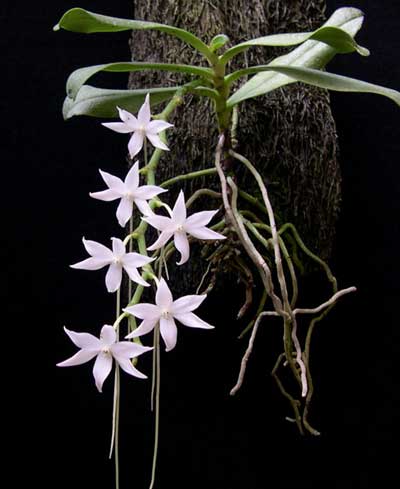
Vandas are native to Southeast Asia and are entirely epiphytic: in nature, they hang from trees or cling to rock crevices, with roots embedding in very little substrate. Their cultivation is simple once the right conditions are found: with adequate light, heat, and humidity, they bloom multiple times a year with flowers ranging from 2.5 to 10 cm in a myriad of colors. Sizes vary from miniature plants to specimens several meters tall. 🌸

The Vanda family is entirely epiphytic: the plants cling to tree bark or rock crevices and rocky areas. Their roots embed in very little soil, only organic matter accumulated over time. Most varieties prefer intense light, heat, and a good degree of humidity.
☀️ Light
Light is a crucial factor for Vanda blooming. There are two main types:
- Flat-leaved: prefer intense light but not full direct sun
- Terete-leaved (pencil-leaved): require full sun and grow best in very bright climates
In a greenhouse: approximately 25-35% shade (less in winter with cloudy skies). Leaves should be medium green, not dark green. In hot, bright climates, they can be grown outdoors with partial shade at midday in summer. Acclimate gradually to avoid sunburn. 🌞
🌡️ Temperature
Vandas love warmth: minimum night temperature 13°C, ideal 15-22°C at night and max 35°C during the day. Higher temperatures accelerate growth but require more humidity, air movement, watering, and fertilization. 💨
Exception: Vanda coerulea (one of the few truly blue orchids) tolerates colder temperatures than other species.
💧 Watering
Most growers prefer to grow Vandas in open baskets with slits, where the roots hang freely in the air. This way they require a lot of water, but the roots must dry quickly. 🚰
During periods of high temperatures, it may be necessary to water twice a day. When watering, immerse the plant until the white/silver roots change color, wait a few minutes, and saturate again (max 8 minutes total). In winter or cloudy weather, water sparingly. Severely dehydrated Vandas can be fully submerged in a bucket of water to rehydrate them.
💨 Humidity
Maintain humidity at or above 65% (ideal 80%). In a greenhouse, use an evaporative cooler or a gravel tray with water under the roots (roots must not touch the water). Air movement must be strong. 🌬️
🌸 Blooming
Vandas bloom year-round under optimal conditions. Flower spikes emerge between the leaves in a predictable pattern and bear multiple flowers that remain open for several weeks. Healthy plants with abundant light, heat, and humidity will bloom at any time. 🌟
⚗️ Fertilization
Vandas are very demanding plants nutritionally: well-fed plants bloom better. During the growing season, fertilize weekly with diluted liquid fertilizer. Fertilize only on the roots or substrate.
- For growth: 20-20-20 (NPK) — 1 g/L, every 14 days
- For blooming: 0-52-34 (MPK) — 1 g/L, every 14 days
🪵 Repotting, Substrate, and Propagation
Vandas grow best in open baskets without substrate, where the large aerial roots can move freely. Large plants often do not need repotting: they grow over the edge of the basket. If necessary, repot every 2 years in spring. After repotting, keep the plant slightly dry for 2 weeks to allow the roots to heal. They prefer terracotta pots (breathable) over plastic. ♻️
If the roots turn brown or mushy, it's rot: cut them, leaving only healthy roots (green or white). Alternatively, cut off dead roots at the base and re-hang the healthy part.


🌳 Alternative Growing Methods
Outdoors, you can tie the roots to a branch with cotton twine (it decomposes in about a year, the same time it takes for the roots to permanently attach). Alternatively, secure the roots to a cork slab to hang on a wall, or simply hang the orchid from a wire hanger. 🧲
🐛 Pests and Common Problems
Fungal and bacterial diseases are frequent due to the necessary humidity. The most common problems: root rot, leaf spots, and wilting. Good ventilation and quick-drying roots are the best prevention. 🚫